Setting up gcc / OpenMP on OSX (Homebrew edition)
- Gcc Compiler For Mac Os X Download 10 11 6
- Gcc Compiler For Mac Os X Download For Mac
- Gcc Compiler For Mac Os X Download Iso Torrent
- Mac Os Gcc Compiler
- Mac Brew Install Gcc
Let's launch a new instance of Terminal, and then we type the command again: gcc -version And this time, we get version information. One interesting tidbit is that we haven't installed gcc. Instead, we installed C-line but it's pretending to be gcc. But for our purposes, it doesn't matter. We have a compiler installed and available from the. More importantly, if you want to develop for OS X, sooner or later you'll have to write some Objective-C code, and that will have to be compiled by the Apple GCC. The only easy way to get a working installation of Apple's GCC is to install XCode, even if you later delete the IDE itself. – user57368 Jun 27 '09 at 22:37.
Dec 25, 2017 Question: Q: How to obtain a GCC on Mac OS X 10.11.6 I have to start coding in C next term (for school) and all of the tutorials on how to install a GCC compiler on Mac involve getting the Xcode app. Unfortunately, whenever I go to download it, it tells me 'Xcode can’t be installed on “Macintosh HD” because OS X version 10.12.6 or later. Use of the legacy GCC 2.95.2-based toolchain is strongly discouraged unless you have to maintain compatibility with OS X version 10.1. If you run into a problem that looks like a compiler bug, try using a different version of GCC. Installing G on a Mac. This section is intended to get you quickly started with C programming on your Mac. Sep 19, 2021 Gnu Tools For Mac Os X 10.7 10 7 Download; Gnu Tools For Mac Os X 10.7 Mac Os X 10 7 Free; I have Mac OS X Mountain Lion. I need to compile a few apps and Perl modules. I already installed Xcode from app store but I’m unable to find gcc compiler or make command.
Watch the updated instructions: Now GCC 9 is out so you need to substitute g-9 with g-7 in the instructions. The GNU Compiler Collection or GCC for short, comprises front ends for C, Objective-C, C, Java, Fortran, Go and Ada, along with libraries for the mentioned languages. GCC us the main component of the GNU toolchain, it is distributed under the GNU General Public License and plays a central role in the continuous growth of free software.
Gcc Compiler Download Mac Os Xforce
Note: This is part of a series of “how-to” blog posts to help new users and developers of BioFVM and PhysiCell. This guide is for OSX users. Windows users should use this guide instead. A Linux guide is expected soon.
These instructions should get you up and running with a minimal environment for compiling 64-bit C++ projects with OpenMP (e.g., BioFVM and PhysiCell) using gcc. These instructions were tested with OSX 10.11 (El Capitan) and 10.12 (Sierra), but they should work on any reasonably recent version of OSX.
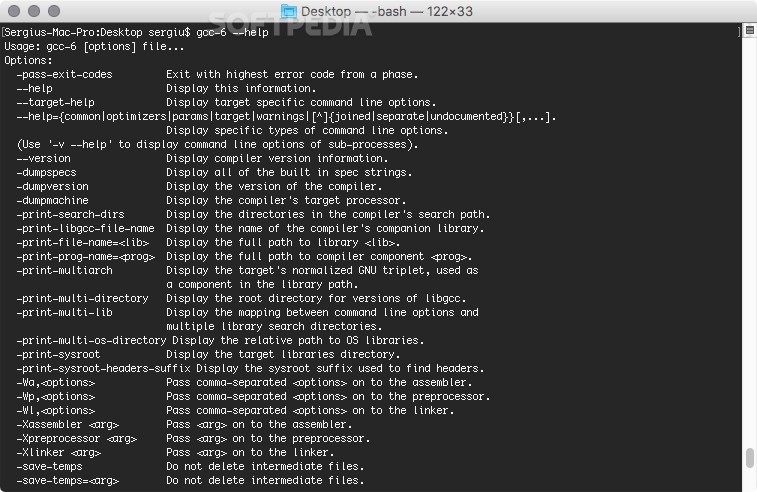
In the end result, you’ll have a compiler and key makefile capabilities. The entire toolchain is free and open source.
Of course, you can use other compilers and more sophisticated integrated desktop environments, but these instructions will get you a good baseline system with support for 64-bit binaries and OpenMP parallelization.
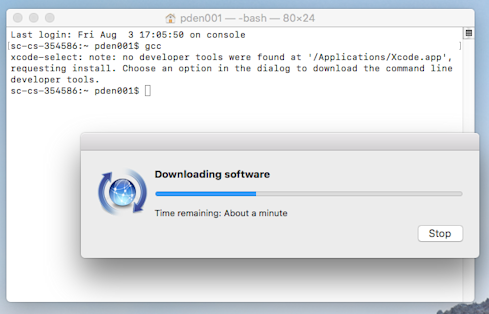
Note 1:OSX / Xcode appears to have gcc out of the box (you can type “gcc” in a Terminal window), but this really just maps back onto Apple’s build of clang. Alas, this will not support OpenMP for parallelization.
Note 2: In this post, we showed how to set up gcc using the popular MacPorts package manager. Because MacPorts builds gcc (and all its dependencies!) from source, it takes a very, very long time. On my 2012 Macbook Air, this step took 16 hours. This tutorial uses Homebrew to dramatically speed up the process!
Note 3: This is an update over the previous version. It incorporates new information that Xcode command line tools can be installed without the full 4.41 GB download / installation of Xcode. Many thanks to Walter de Back and Tim at the Homebrew project for their help!
What you’ll need:
- XCode Command Line Tools: These command line tools are needed for Homebrew and related package managers. Installation instructions are now very simple and included below. As of January 18, 2016, this will install Version 2343.
- Homebrew: This is a package manager for OSX, which will let you easily download and install many linux utilities without building them from source. You’ll particularly need it for getting gcc. Installation is a simple command-line script, as detailed below. As of August 2, 2017, this will download Version 1.3.0.
- gcc (from Homebrew): This will be an up-to-date 64-bit version of gcc, with support for OpenMP. As of August 2, 2017, this will download Version 7.1.0.
Main steps:
1) Install the XCode Command Line Tools
Open a terminal window (Open Launchpad, then “Other”, then “Terminal”), and run: Download lync client 2013 for mac.
A window should pop up asking you to either get Xcode or install. Choose the “install” option to avoid the huge 4+ GB Xcode download. It should only take a few minutes to complete.
2) Install Homebrew
Open a terminal window (Open Launchpad, then “Other”, then “Terminal”), and run: How to download spigot on mac.
Let the script run, and answer “y” whenever asked. This will not take very long.
3) Get, install, and prepare gcc
Open a terminal window (see above), and search for gcc, version 7.x or above
You should see a list of packages, including gcc7. (In 2015, this looked like “gcc5”. In 2017, this looks like “[email protected]”.)
Then, download and install gcc:
This will download whatever dependencies are needed, generally already pre-compiled. The whole process should only take five or ten minutes.
Lastly, you need to get the exact name of your compiler. In your terminal window, type g++, and then hit tab twice to see a list. On my system, I see this:
Look for the version of g++ without an “mp” (from MacPorts) in its name. In my case, it’s g++-7. Double-check that you have the right one by checking its version. It should look something like this:
Notice that Homebrew shows up in the information. The correct compiler is g++-7.

PhysiCell Version 1.2.2 and greater use a system variable to record your compiler version, so that you don’t need to modify the CC line in PhysiCell Makefiles. Set the PHYSICELL_CPP variable to record the compiler you just found above. For example, on the bash shell:
One last thing: If you don’t update your paths, make will may fail as it continues to combine Apple’s “gcc” toolchain with real gcc. (This seems to happen most often if you installed an older gcc like gcc5 with MacPorts earlier.) You may see errors like this:
To avoid this, run:
Note that you’ll need to open a new Terminal window for this fix to apply.
4) Test your setup
I wrote a sample C++ program that tests OpenMP parallelization (32 threads). If you can compile and run it, it means that everything (including make) is working! :-)
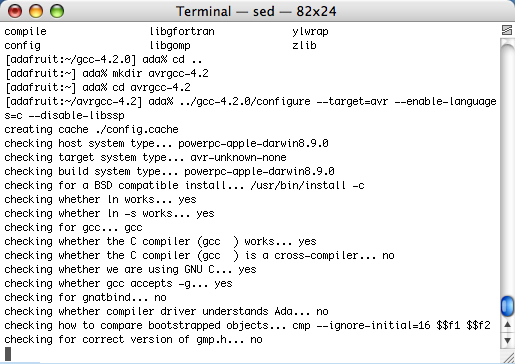
Make a new directory, and enter it
Open Terminal (see above). You should be in your user profile’s root directory. Make a new subdirectory called GCC_test, and enter it.
Grab a sample parallelized program:
Download a Makefile and C++ source file, and save them to the GCC_test directory. Here are the links:
- Makefile: [click here]
- C++ source: [click here]
Note: The Makefiles in PhysiCell (versions > 1.2.1) can use an environment variable to specify an OpenMP-capable g++ compiler. If you have not yet done so, you should go ahead and set that now, e.g., for the bash shell:
Compile and run the test:
Go back to your (still open) command prompt. Compile and run the program:
The output should look something like this:
Note 1: If the make command gives errors like “**** missing separator”, then you need to replace the white space (e.g., one or more spaces) at the start of the “$(COMPILE_COMMAND)” and “rm -f” lines with a single tab character.
Note 2: If the compiler gives an error like “fatal error: ‘omp.h’ not found”, you probably used Apple’s build of clang, which does not include OpenMP support. You’ll need to make sure that you set the environment variable PHYSICELL_CPP as above (for PhysiCell 1.2.2 or later), or specify your compiler on the CC line of your makefile (for PhysiCell 1.2.1 or earlier).
Now, let’s verify that the code is using OpenMP.
Open another Terminal window. While the code is running, run top. Take a look at the performance, particularly CPU usage. While your program is running, you should see CPU usage fairly close to ‘100% user’. (This is a good indication that your code is running the OpenMP parallelization as expected.)
What’s next?
Download a copy of PhysiCell and try out the included examples! Visit BioFVM at MathCancer.org.
- PhysiCell links:
- PhysiCell Method Paper at bioRxiv: https://doi.org/10.1101/088773
- PhysiCell on MathCancer: http://PhysiCell.MathCancer.org
- PhysiCell on SourceForge: http://PhysiCell.sf.net
- PhysiCell on github: http://github.com/MathCancer/PhysiCell
- PhysiCell tutorials: [click here]
- BioFVM links:
- BioFVM announcement on this blog: [click here]
- BioFVM on MathCancer.org: http://BioFVM.MathCancer.org
- BioFVM on SourceForge: http://BioFVM.sf.net
- BioFVM Method Paper in BioInformatics: http://dx.doi.org/10.1093/bioinformatics/btv730
- BioFVM tutorials: [click here]

NOTE: some links may be broken - older binaries have been lost in an incident.
Mandatory tools
In order to compile R for Mac OS X 10.4 or higher, you will need the following tools: (for Mac OS X 10.5 and higher look further down)- Xcode Development Tools 2.4.0 (or higher) from Apple
They can be obtained from Apple's Xcode pages. Also, all recent Mac OS X versions come bundled with Xcode Tools, they are located on the installation DVD. However, if your OS X came with Xcode older than version 2.4.0, you will have to download a more recent version from the above site.Note: The binary Leopard build of R on CRAN requires Xcode 3.1 or higher
- GNU Fortran compiler
Unfortunately Xcode doesn't contain a Fortran compiler, therefore you will have to install one. For convenience we provide a binary of the GNU Fortran compiler, because most other binaries are either incomplete or broken (do not use compilers from HPC, they won't work correctly!). You can download it from CRAN or here:gfortran-4.2.3.dmg (ca. 27MB, GNU Fortran 4.2.3 release)
MD5 hash: 9551fc46f55537dd1db581154daf27ef
This binary contains gfortran 4.2.3 (release) for both Intel and PowerPC Macs. It supports all four targets (i386, ppc, x86_64 and ppc64) and features Apple's Darwin compiler drivers, i.e. you can build fat binaries with one command (e.g. gfortran -arch i386 -arch ppc -o tf tf.f).Make sure you add /usr/local/bin to your PATH in order to use this compiler. This can be done, e.g. by
export PATH=$PATH:/usr/local/binNote: If you are interested in cutting-edge compilers and/or integration of GNU Fortran and Apple's compilers see gcc 4.2 section below. That section is also the right place to go if you use the binary Leopard build of R.
Previous versions:
gfortran-4.2.1.dmg (ca. 28MB, 4.2.1 release, also avaiable in R 2.6.0)
gfortran-4.2.0.dmg (ca. 28MB, 4.2.0 release, also avaiable in R 2.5.1)
gfortran-4.2.0-20070325.dmg (ca. 16MB, 4.2.0 2007/03/25 pre-release without cc back-end)
Mandatory Tools - Leopard CRAN build
Gcc Compiler For Mac Os X Download 10 11 6
R build can be built with the above requirements, but if you want to use source compilation with the CRAN build of R for Mac OS X 10.5 or higher (aka Leopard build), you will need more recent tools:- Xcode Development Tools 3.1 (or higher) from Apple with gcc-4.2
They can be obtained from Apple's Xcode pages. Make sure gcc-4.2 is selected during the installation (default in recent Xcode versions). - GNU Fortran compiler
Do not install Fortran compilers that comde with Tiger builds of R. Remove them using sudo gfortran-uninstall if you installed them before (unless you want to use both builds in parallel). Then install gfortran-4.2 addition to Apple compilers (see below - you have to pick the one that maches your Xcode version!). Although the Tiger compilers supplied with the Tiger build of R can be used, they will result in slightly different binaries.
Optional tools and libraries
Gcc Compiler For Mac Os X Download For Mac
The following tools and libraries are optional. R can be compiled without them, but they provide additional capabilities to R.- LaTeX
In order to produce documentation, LaTeX is necessary. It can be obtained from several places, for example as a part of MacTeX. - GNU readline
Although Mac OS X comes with readline-replacement library, it lack some functionality like backward search etc. Therefore many user prefer GNU readline. Binary for all four architectures is provided from CRAN as a part of the devpack: Tools on CRAN or see libs on this site for more recent versions. - PNG and JPEG libraries
If bitmap manipulation libraries are present, R will add graphics device support for those bitmap formats. There are also other package that take advantage of PNG and JPEG, so it is in general a good idea to install them.Again, they are now part of the devpack on CRAN: Tools on CRAN or more recent versions are available from libs. - cairo
R 2.7.0 comes with cairo support. The following tar-ball contains cairo and its dependencies (FreeType, pkgconfig and png) in static form such that you can compile R the same way it is compiled for CRAN:Tools on CRAN
Apple Xcode gcc-42 add-ons
- GNU Fortran 4.2.4 for Mac OS X 10.7 (Lion):
Download: gfortran-lion-5666-3.pkg (for Xcode 4.1)
This package adds GNU Fortran to Xcode 4.1 for Lion (Apple's gcc 4.2 build 5666.3). Requires Mac OS X 10.7 (Lion) and Xcode 4.1.gcc-4.2 (Apple build 5666.3) with GNU Fortran 4.2.4 for Mac OS X 10.7 (Lion):
Download: gcc-42-5666.3-darwin11.pkg (for Xcode 4.2 and higher)
This package contains gcc-4.2 (Apple build 5666.3) including GNU Fortran for Mac OS X 10.7 (Lion). It is needed for Xcode 4.2 or higher since Apple has dropped gcc-4.2 from Xcode. It works with Xcode 4.0 and 4.1 as well, but there you can use the above smaller Fortran package instead. - GNU Fortran 4.2.4 for Mac OS X 10.6 (Snow Leopard):
Download: gfortran-42-5664.pkg (for Xcode 3.2.3 through 3.2.5)
This package adds GNU Fortran to Xcode 3.2.3/4/5 for Snow Leopard (Apple's gcc 4.2 build 5664). Requires Mac OS X 10.6 (Snow Leopard) and Xcode 3.2.3, 3.2.4 or 3.2.5 (it will also work with more recent Xcode such as 4.0 or 4.1 on Snow Leopard since Apple stopped updating gcc)
Download: gfortran-42-5659.pkg (for Xcode 3.2.2)
This package adds GNU Fortran to Xcode 3.2.2 for Snow Leopard (Apple's gcc 4.2 build 5659). Requires Mac OS X 10.6 (Snow Leopard) and Xcode 3.2.2.
Download: gfortran-42-5646.pkg (for Xcode 3.2 and 3.2.1)
This package adds GNU Fortran to Xcode 3.2 for Snow Leopard (Apple's gcc 4.2 build 5646). Requires Mac OS X 10.6 (Snow Leopard) and Xcode 3.2 (or 3.2.1).Dynamic libgfortran: libgfortran-4.2.4-5646.tar.gz (NOT needed for R)
The compiler above contains static libgfortran. To avoid library pollution the dynamic gfortran library is not included since it is not necessary for most projects and causes problems for people that don't have it installed at run-time. If you know what you're doing, you can install it, but be aware that your FORTRAN binaries will depend on it and OS X does NOT include it.
Install: sudo tar fxz libgfortran-4.2.4-5646.tar.gz -C / - GNU Fortran 4.2.4 for Mac OS X 10.5 (Leopard):
Download: gfortran-42-5577.pkg (for Xcode 3.1.4 only!)
This package adds GNU Fortran 4.2.4 to Apple's Xcode 3.1.4 gcc 4.2 (build 5577) compilers on Mac OS X 10.5 (Leopard). It does NOT work on Snow Leopard. This binary has been built the Apple way with the gcc_42 (build 5577) sources (by adding the Fortran directories from gcc 4.2.4 release), so it features full Apple driver (i.e. all special flags work) and works directly with the gcc 4.2 system compiler. You have to install Xcode 3.1.4 first (from ADC).Older versions:
GNU Fortran 4.2.4 for Apple's gcc-4.2 (build 5564) = Xcode 3.1 and 3.1.1:
gfortran-4.2-5564-darwin9.tar.gz
GNU Fortran 4.2.4 for Apple's gcc-4.2 (build 5566) = Xcode 3.1.2:
gfortran-4.2-5566-darwin9.tar.gz
GNU Fortran 4.2.4 for Apple's gcc-4.2 (build 5577) = Xcode 3.1.4:
gfortran-4.2-5577-darwin9.tar.gz (same as the above installer)
Installation: sudo tar fvxz gcc-4.2-5577-darwin9-all.tar.gz -C / - gcc 4.2 (Apple Inc. build 5566) for Mac OS X 10.4 (Tiger): (updated 2008/12/24)
Download: gcc-4.2-5566-darwin8-all.tar.gz (Apple gcc 4.2 build 5566 [as in Xcode 3.1.2] + GNU Fortran 4.2.4)
The above tar-ball contains compilers, docs and 10.4u SDK - unpack using:
sudo tar fvxz gcc-4.2-5566-darwin8-all.tar.gz -C /
The above compilers don't replace existing 4.0 or older compilers, use as gcc-4.2, g++-4.2 etc. or create symlinks if you want to make it the default compiler (or use sudo gcc_select 4.2).
(Note: SDK and documentation is assumed to live in /Developer - move accordingly for non-standard installations).
Previous (older) versions
- gcc 4.2 (Apple Inc. build 5553) for Mac OS X 10.4 (Tiger):
Download: gcc-42-5553-darwin8-all.tar.gz (Apple gcc 4.2 build 5553 + GNU Fortran 4.2.3)
The above tar-ball contains compilers, docs and 10.4u SDK - unpack using:
sudo tar fvxz gcc-42-5553-darwin8-all.tar.gz -C /
The above compilers don't replace existing 4.0 or older compilers, use as gcc-4.2, g++-4.2 etc. or create symlinks if you want to make it the default compiler. - gcc 4.2 (Apple Inc. build 5531) for Mac OS X 10.4 (Tiger) (older than above):
Download: gcc-42-5531-darwin8.tar.gz (Apple gcc 4.2 build 5531)
Download: gcc-42-5531-darwin8-SDK.tar.gz (MacOSX10.4u SDK files)
Download: gfortran-42-5531-darwin8.tar.gz (GNU Fortran)
This is a set of Apple's gcc 4.2.1 (build 5531) compilers for Mac OS X 10.4 (Tiger). Xcode 2.5 has gcc 4.0 only, and gcc 4.2 update is currently available only for Leopard, so this binary fills the gap.
The second file contains the Fortran compiler which is not part of the Apple sources, but was compiled along with the Apple sources.
Building a universal compiler
Note: This section is now becoming obsolete given Apple's gcc 42 branch, but it is kept here until we have more definite information on Apple's Fortran support. If you're interested in compiling Apple's gcc-4.2 branch with Fortran support, add Fortran sources and use this patch: gfortran-5564.diff (for gcc-4.2 Apple build 5564/5566/5577 and GNU Fortran 4.2.4) or gfortran-5531.diff (for gcc-4.2 Apple builds 5531 or 5553 and GNU Fortran 4.2.3). Complete sources are also in /src.Apple provides universal compilers in their Xcode tools. This means that the compiler itself can be run on both on Intel and PowerPC Macs natively. In addition, Apple's compilers can produce binaries for any of the architectures i386, ppc, x86_64 and ppc64. This mean that the same compiler suite is usable on any Mac and can target any Mac as well.
Apple also provides a special driver for all compilers such that they support additional flags such as -arch which allow us to build fat binaries in one run. Internally the driver invokes multple separate compilers, one for each distincts -arch flag and combines the result using lipo. This is highly convenient and allows for compilation of the form:
gcc -c foo.c -arch ppc -arch i386 -arch ppc64 -arch x86_64
which produces one fat object file (foo.o) containing binaries for all four architectures.
Unfortunately Apple's branch of gcc is based on a fairly old version of gcc and they don't support Fortran. (Update: 2007/11 there is some hope, Apple's gcc-42 branch can be used to compile Fortran - see binaries above - and Apple is allegedly working on an official Fortran release) Therefore it is sometimes necessary to compile gcc from the original FSF sources. However, such compilers (e.g. as provided by HPC) are very limited, because they work only on one kind of Mac (Intel or PPC) and don't support cross-compiling. Therefore is it necessary to merge Apple's approach and FSF gcc sources to create a more usable compiler for Mac OS X.
In this part I want to describe steps necessary to create such universal compiler from any gcc sources. The whole process is fully automated by a shell script which can be obtained here (it must be run sudo unless you have write-premissions in /usr/local). I have used this procedure to create the Fortran compiler available above. Run the script with '-h' flag to see all the options.
How does it work?
Conceptually Apple's drivers use naming scheme to distinguish compilers for Intel and PowerPC targets. In the Xcode installation they are called powerpc-apple-darwin8-gcc-4.0.1 and i686-apple-darwin8-gcc-4.0.1. The virtual targets ppc64 and x86_64 are compiled by adding -m64 flags to the corresponding compiler. The driver (Gcc Compiler For Mac Os X Download Iso Torrent
gcc-4.0) invokes the actual compiler(s) that are needed and usesMac Os Gcc Compiler
lipo to create the resulting fat object/binary.In order to build an universal compiler suite, we need to proceed using these steps:
- get cross-compilation tools
The building process requires tools for cross-compilation to be of the form <arch>-apple-darwin8-<tool>. However, Apple's tools expect the -arch flag instead of naming conventions. Therefore it is necessary to create small stubs that map FSF naming conventions into corresponding invocations of the Apple tools. Such stubs are automatically generated by Apple's gcc bulding process, but they are also available in this file: gcc-bin-stubs.tar.gz - get gcc sources
This is obviuos, you clearly need gcc sources. One way to get them is via svn, for example:
svn co svn://gcc.gnu.org/svn/gcc/branches/gcc-4_2-branch gcc-4.2 - compile and install the native compilers
The compilation part is straight-forward, just configure and build gcc for the i686-apple-darwin8 host and powerpc-apple-darwin8 host. The harder part is the installation, because Apple uses fat files, whereas FSF's multilibs relies on different names. First install one architecture, rename the binaries according to Apple's compiler name conventions and move everything in /usr/local/lib aside. Then install the other architecture and do the same. Finally combine all system libraries using lipo into /usr/local/lib. This applies also to 64-bit architectures which should also be included in the libraries placed in /usr/local/lib. Then get all the other files and symlinks back. Finally remove everything from the subdirectories in lib and replace it with symlinks. This should give you a working environment for all four targets. Finally adjust the IDs of the libraries to match their location. - compile and merge cross-compilers
With the above compiler we cannot create universal binaries, because the cross-compilers are missing. We need to compile them now. Note that we don't need libraries anymore, because they are already in place, so even if some of the libraries fail when cross-compiled, we don't care. The cross-compilers don't even need to be installed, just lipo the binaries of the cross-compilers into /usr/local/libexec/gcc/*-apple-darwin*/* and the drivers into /usr/local/bin with the corresponding name. You may want to strip them as well in order to reduce size. - get and install the Darwin driver
The driver is part of Apple's gcc and can be obtained correspondingly. I have packaged the minimal sources and the corresponding Makefile into one small tar-ball which is available here: gcc-darwin-driver.tar.gz. It is based on gcc-5363 sources released by Apple, but the Makefile allows the use of any Apple's gcc sources - just set AGCC accordingly. Move the resulting driver files into /usr/local/bin and you're all set!