- Gallio Includes ReSharper Support. We Are Also Working To Improve Performance. Not Sure Which Version Of Icarus You Tried But I Haven't Seen It Cr...
- Pycharm Unittest Runner
- Python - Running A Single Test From Unittest.TestCase Via The ...
- Cached
- See Full List On Github.com
This tutorial takes you through an interactive experience building a sample solution step-by-step to learn unit testing concepts. If you prefer to follow the tutorial using a pre-built solution, view or download the sample code before you begin. For download instructions, see Samples and Tutorials.
This article is about testing a .NET Core project. If you're testing an ASP.NET Core project, see Integration tests in ASP.NET Core.
Let’s now run unittests on another program, since you won’t be writing your entire application inside a unittest file! Let’s write a simple application program and perform unit tests on it. I’ll be writing a program that acts as a very simple database to store the names and marks of students.
Renamed from JUnit test reports to Unit test reports in GitLab 13.4. It is very common that a CI/CD pipeline contains a test job that verifies your code. If the tests fail, the pipeline fails and users get notified. The person that works on the merge request has to check the job logs and see where the tests failed so that they can fix them. The following steps are involved in creating and running a test suite. Step 1 − Create an instance of TestSuite class. Suite = unittest.TestSuite Step 2 − Add tests inside a TestCase class in the suite. Suite.addTest(testcase class) Step 3 − You can also use makeSuite method to add tests from a class. Test runner-component for organizing the execution of tests and for delivering the outcome to the user. In this Python Unittest tutorial, we will use the unittest module to demonstrate our examples to you. Python Unittest Example. In the following example of Unittest in Python, we will take a simple function that calculates the modulus 3 of a. Organize tests in a test suite. The basic idea here is to have a new Python file runner.py alongside your tests that contains our runner. It looks something like the following: # tests/runner.py import unittest # import your test modules import player import scenario import thing # initialize the test suite loader = unittest.TestLoader suite.
Prerequisites
- The .NET 5.0 SDK or later
Create the source project
Open a shell window. Create a directory called unit-testing-using-mstest to hold the solution. Inside this new directory, run dotnet new sln to create a new solution file for the class library and the test project. Create a PrimeService directory. The following outline shows the directory and file structure thus far:
Gallio Includes ReSharper Support. We Are Also Working To Improve Performance. Not Sure Which Version Of Icarus You Tried But I Haven't Seen It Cr...
Make PrimeService the current directory and run dotnet new classlib to create the source project. Rename Class1.cs to PrimeService.cs. Replace the code in the file with the following code to create a failing implementation of the PrimeService class:
Change the directory back to the unit-testing-using-mstest directory. Run dotnet sln add to add the class library project to the solution:
Create the test project
Create the PrimeService.Tests directory. The following outline shows the directory structure:
Make the PrimeService.Tests directory the current directory and create a new project using dotnet new mstest. The dotnet new command creates a test project that uses MSTest as the test library. The template configures the test runner in the PrimeServiceTests.csproj file:
The test project requires other packages to create and run unit tests. dotnet new in the previous step added the MSTest SDK, the MSTest test framework, the MSTest runner, and coverlet for code coverage reporting.
Add the PrimeService class library as another dependency to the project. Use the dotnet add reference command:
You can see the entire file in the samples repository on GitHub.
The following outline shows the final solution layout:
Change to the unit-testing-using-mstest directory, and run dotnet sln add:
Create the first test
Write a failing test, make it pass, then repeat the process. Remove UnitTest1.cs from the PrimeService.Tests directory and create a new C# file named PrimeService_IsPrimeShould.cs with the following content:
The TestClass attribute denotes a class that contains unit tests. The TestMethod attribute indicates a method is a test method.
Save this file and execute dotnet test to build the tests and the class library and then run the tests. The MSTest test runner contains the program entry point to run your tests. dotnet test starts the test runner using the unit test project you've created.
Your test fails. You haven't created the implementation yet. Make this test pass by writing the simplest code in the PrimeService class that works:
In the unit-testing-using-mstest directory, run dotnet test again. The dotnet test command runs a build for the PrimeService project and then for the PrimeService.Tests project. After building both projects, it runs this single test. It passes.
Add more features
Now that you've made one test pass, it's time to write more. There are a few other simple cases for prime numbers: 0, -1. You could add new tests with the TestMethod attribute, but that quickly becomes tedious. There are other MSTest attributes that enable you to write a suite of similar tests. A test method can execute the same code but have different input arguments. You can use the DataRow attribute to specify values for those inputs.
Instead of creating new tests, apply these two attributes to create a single data driven test. The data driven test is a method that tests several values less than two, which is the lowest prime number. Add a new test method in PrimeService_IsPrimeShould.cs:
Run dotnet test, and two of these tests fail. To make all of the tests pass, change the if clause at the beginning of the IsPrime method in the PrimeService.cs file:
Continue to iterate by adding more tests, more theories, and more code in the main library. You have the finished version of the tests and the complete implementation of the library.
You've built a small library and a set of unit tests for that library. You've structured the solution so that adding new packages and tests is part of the normal workflow. You've concentrated most of your time and effort on solving the goals of the application.
See also
- UnitTest Framework Tutorial

- UnitTest Framework Resources
- Selected Reading
'unittest' supports test automation, sharing of setup and shutdown code for tests, aggregation of tests into collections, and independence of the tests from the reporting framework.
The unittest module provides classes that make it easy to support these qualities for a set of tests.
Pycharm Unittest Runner
To achieve this, unittest supports the following important concepts −
test fixture − This represents the preparation needed to perform one or more tests, and any associate cleanup actions. This may involve, for example, creating temporary or proxy databases, directories, or starting a server process.
test case − This is the smallest unit of testing. This checks for a specific response to a particular set of inputs. unittest provides a base class, TestCase, which may be used to create new test cases.
test suite − This is a collection of test cases, test suites, or both. This is used to aggregate tests that should be executed together. Test suites are implemented by the TestSuite class.
test runner − This is a component which orchestrates the execution of tests and provides the outcome to the user. The runner may use a graphical interface, a textual interface, or return a special value to indicate the results of executing the tests.
Creating a Unit Test
The following steps are involved in writing a simple unit test −
Step 1 − Import the unittest module in your program.
Step 2 − Define a function to be tested. In the following example, add() function is to be subjected to test.
Step 3 − Create a testcase by subclassing unittest.TestCase.
Step 4 − Define a test as a method inside the class. Name of method must start with 'test'.
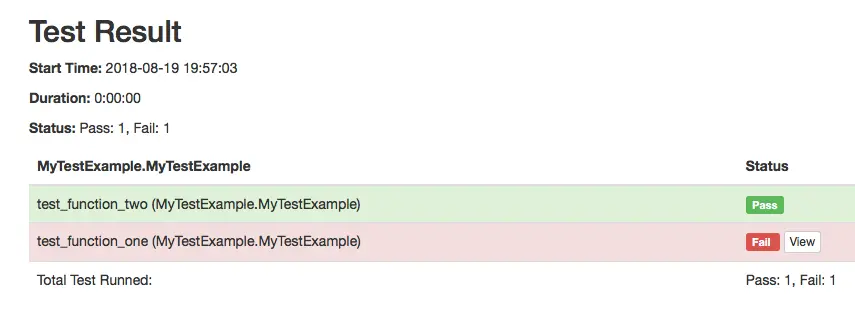
Step 5 − Each test calls assert function of TestCase class. There are many types of asserts. Following example calls assertEquals() function.
Step 6 − assertEquals() function compares result of add() function with arg2 argument and throws assertionError if comparison fails.
Step 7 − Finally, call main() method from the unittest module.
Step 8 − Run the above script from the command line.
Step 9 − The following three could be the possible outcomes of a test −
| Sr.No | Message & Description |
|---|---|
| 1 | OK The test passes. ‘A’ is displayed on console. |
| 2 | FAIL The test does not pass, and raises an AssertionError exception. ‘F’ is displayed on console. |
| 3 | ERROR The test raises an exception other than AssertionError. ‘E’ is displayed on console. |
These outcomes are displayed on the console by '.', 'F' and 'E' respectively.
Command Line Interface
Python - Running A Single Test From Unittest.TestCase Via The ...
The unittest module can be used from the command line to run single or multiple tests.
unittest supports the following command line options. For a list of all the command-line options, use the following command −
Cached
| Sr.No | Option & Description |
|---|---|
| 1 | -h, --help Show this message |
| 2 | v, --verbose Verbose output |
| 3 | -q, --quiet Minimal output |
| 4 | -f, --failfast Stop on first failure |
| 5 | -c, --catch Catch control-C and display results |
| 6 | -b, --buffer Buffer stdout and stderr during test runs |